
Buddhism in Taungoo Period
The Taungoo period in Myanmar history lasted over a century (1486-1594 AD). It was a dynasty of four kings namely…

1.	Min Kyi Nyo (1485-1531 AD),
2.	Tabin Shwe Hti (1531-1550 AD),
3.	Bayint Naung (1551-1581 AD), and
4.	Nandabayin (1581-1594 AD), of them the second and the third were the conqueror kings who built the second Myanmar Empire.

During this time span of 108 years, wars were waged at home and abroad for national reconsolidation, defense and extension of the kingdom. Many military campaigns were led by Tabin Shwe Hti and his successor Banyint Naung with resounding victories. But these two conqueror kings like Alexander the great of Macedonia who led the campaigns of Hellenization, carried out the propagation of Buddhism and Buddhist culture during their campaigns to remote areas especially Shan states. They forbade the primitive practices of sacrificing animals at Nat festivals, burning alive servants and lesser queens with the dead body of a feudal lord so as to accompany the latter in the next existence, great feats of ancestor worship was allowed but strong liquor and other intoxicants were strictly forbidden.
In those days the custom still survived in the Shan States of killing animals and even men and women, and burying them with their dead chiefs. When the Emperor heard of it, he put a stop to this barbarous custom.
Pagodas were built for veneration of the local people and monasteries were constructed where missionary monks were asked to reside to spread the teachings of the Buddha to the tribes. Food, clothing, shelter and medicine were provided by the kings to the missionary monks as long as the latter performed their religious duties in the remote areas where animism and debased Buddhism still pervaded. (Four basic needs for a monk namely food (alms), clothing (yellow robe), shelter (monastery) & medicine).

Tribal chiefs were required to take the oath of allegiance to the king and promise to abandon their primitive rites of animal and human sacrifices such as head hunting, slaughtering animals, burning lesser wives and servants with the dead body of a feudal chief. They were given favor and reward by upgrading their status if they followed the teachings of the Bhikkhus. King Bayint Naung, during his military campaigns throughout the country abolished the custom of slaughtering white animals such as buffaloes, cows, goats, pigs and fowls to the Mahagiri spirits and adorning the shrine with their skulls. This primitive custom was prevalent among the people living around the Popa hill, Bagan, Ywatha, Salei, Pakhan-nge, Nga-tha-yauk, Tuyin, Kyauk Padaung.
It was then the custom in the parts of Sagu and Salin to hold sacrifices of pigs, fowl and buffaloes in honour of dead ancestors; this was forbidden by command of the King. Even the festivals in honour of the Mahagiri nats at which animals were sacrificed, were brought to a stop.
Nat worship however still survives, in a modified form; coconuts dedicated to the nats are still hung in houses.
Thanks to the patronage and support of King Bayint Naung Buddhism spread and flourished. Taking Ashoka as his model Buddhist king, Bayint Naung, build pagodas in Chienmai, Linzin, Ayutthaya and Shan States (Ko-Shan-Pyay), built monasteries for missionary monks, provided four needs of the bhikkhus, distributed copies of Tipitakas. Many of the pagodas he built still survive in the countries he conquered. He was the donor of mass ordinations at the Kalyani Sima. In doing such works of religious merit this king of Taungoo dynasty was acclaimed by his people as the great Sasana Dayakar( royal inheritor of Buddha Sasana). He hoisted hti (umbrella), on Shwedagon, Shwemawdaw, Kyaikhtiyo and many other lesser pagodas, adorned these htis with precious stones from his crown. Bayint Naung built in the vicinity of Shwemawdaw pagoda at Bago as many monasteries as there were years in his life at the time; 52 and donated the cost of ordination a similar number of monks.

In AD 1564, an earthquake damaged the Shwedagon pagoda toppling its hti. That earthquake coincided with his queen’s death. He repaired the pagoda and put on it a new hti studded with crown jewels. In AD 1567, he carried out Tula dana. Tula dana is the giving to religion of gold of the giver’s body weight. A replica of the sacred tooth of the Buddha and a stone alms bowl with many religions objects were presented to him by the Buddhist king of Srilanka as a token of thanks to Bayint Naung for the latter’s military assistance in crushing the Chola rebels.

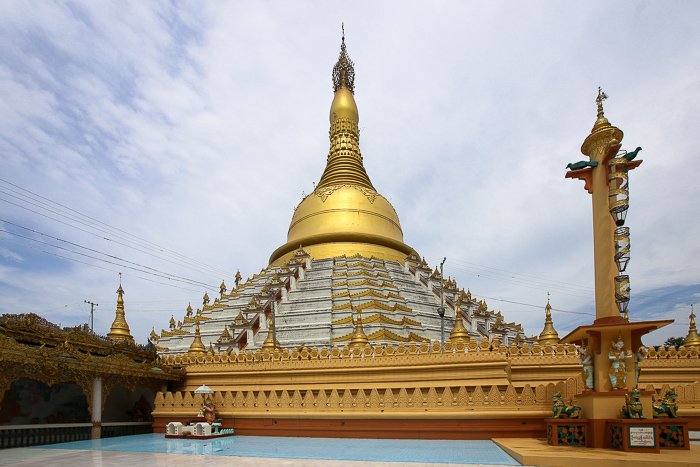
A big stupa called Mahazedi was built at his capital Hamsavadi (Bago) and in it were enshrined all religious gifts from Srilanka and gold images of himself, the royal family and courtiers of inner circle, weighing their body weight. Relations with Buddhist countries were maintained and strengthed by frequent contacts by land and sea. Royal chronicles of Srilanka and Myanmar have records of religious and diplomatic missions exchanged between two countries. In 1555 AD, Bayint Naung sent a mission to donate rich presents to the Sacred Tooth at Kandy, including the broom made of his hair and that of his chief queen with a gold handle studded with gems to sweep the shrine of the Sacred Tooth, so that they gained religious merit. In that way he proved to his people that he performed his functions as head of the state as well as that of the religion.
| Mahazedi Overview from the southeast |
|---|
 |
Bayint Naung purchased lands in Srilanka to build Viharas for Myanmar monks and rest houses for Myanmar pilgrims and to give to the laborers he employed to light candles at the Kandy Shrine. He also sent from time to time to Srilanka, Myanmar masons and craftsmen to repair renovate and beautifully Buddhist temples and pagodas there. In Srilanka Buddhism was often subjected to the on Sought of Chola rebellions and later Portuguese invaders. Bayint Naung sent his soldiers and monks to put down the rebels and to repulse the invadrs and to revive Buddhism.

In 1576 AD, the king of Srilanka sent a replica of the sacred Tooth and a princess to King Bayint Naung. Bayint Naung in state went to Pathein sea port to welcome and receive the sacred Tooth and returned to his capital with full regatta. The sacred Tooth was conveyed in a gem studded gold casket to his palace where it was placed in a shrine on a spired relic tower. Later it was enshrined in the Mahazedi pagoda at Bago. Though Buddhism continued to flourish in the Taungoo period, rivalry of Christianity was beginning to be felt as the Portuguese adventures mercenaries and missionaries arrived and set up their strongholds.
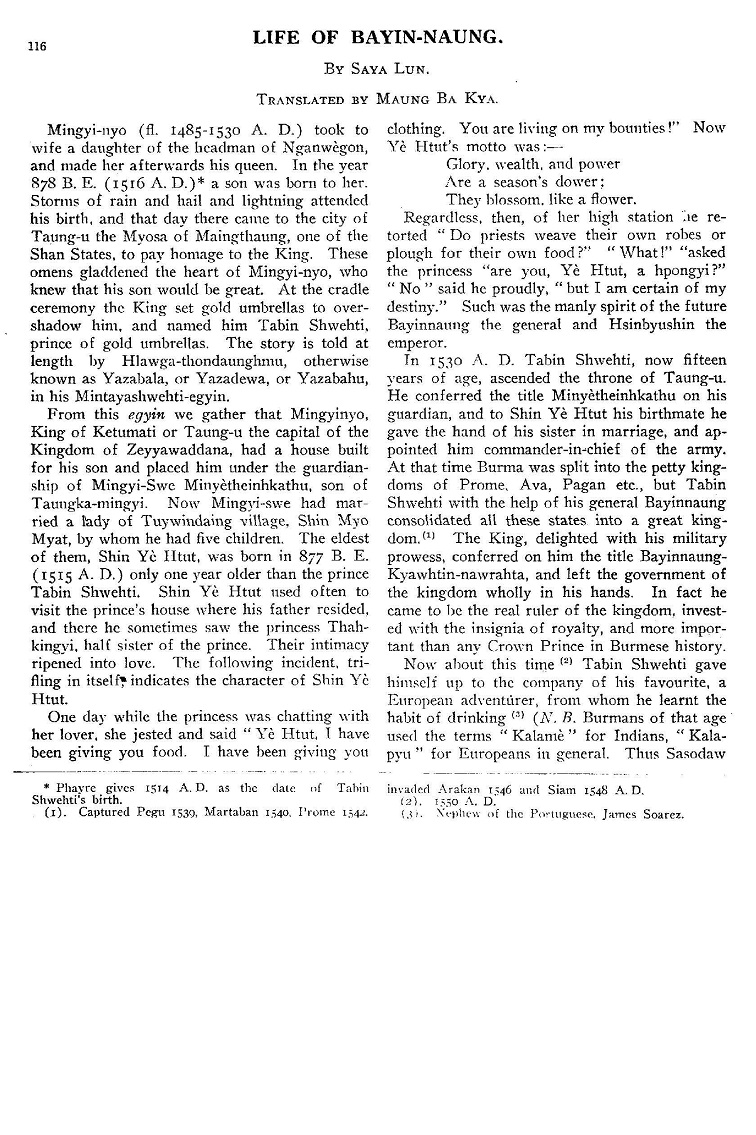
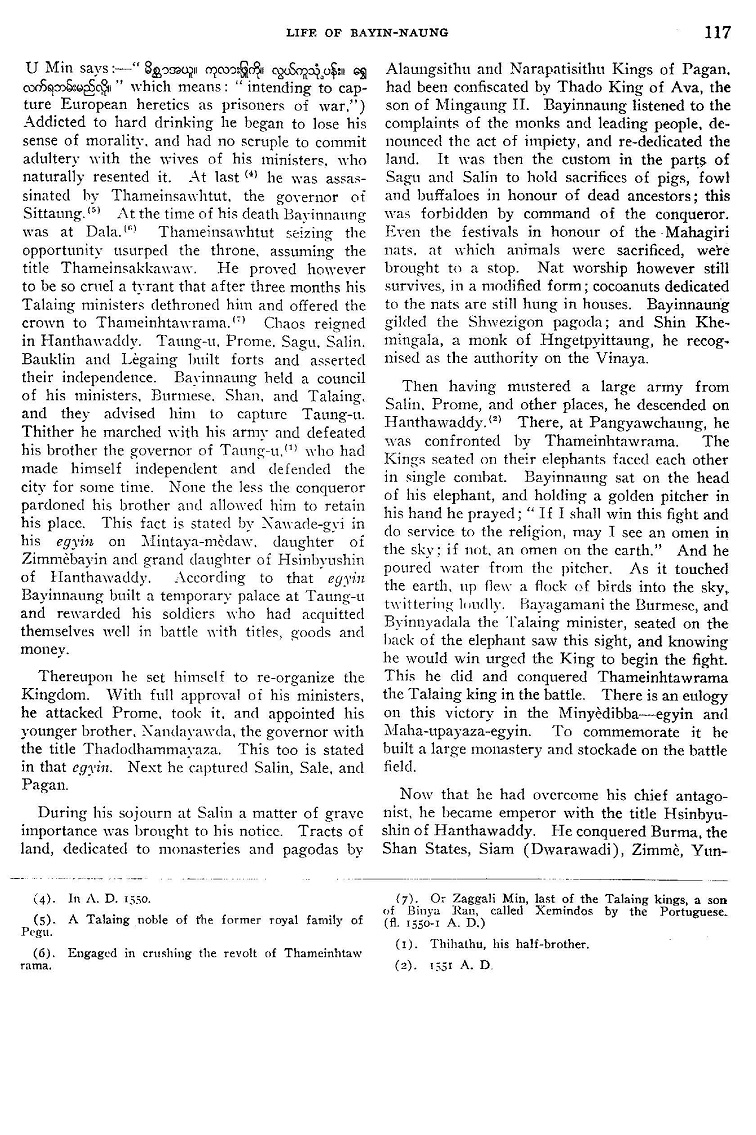
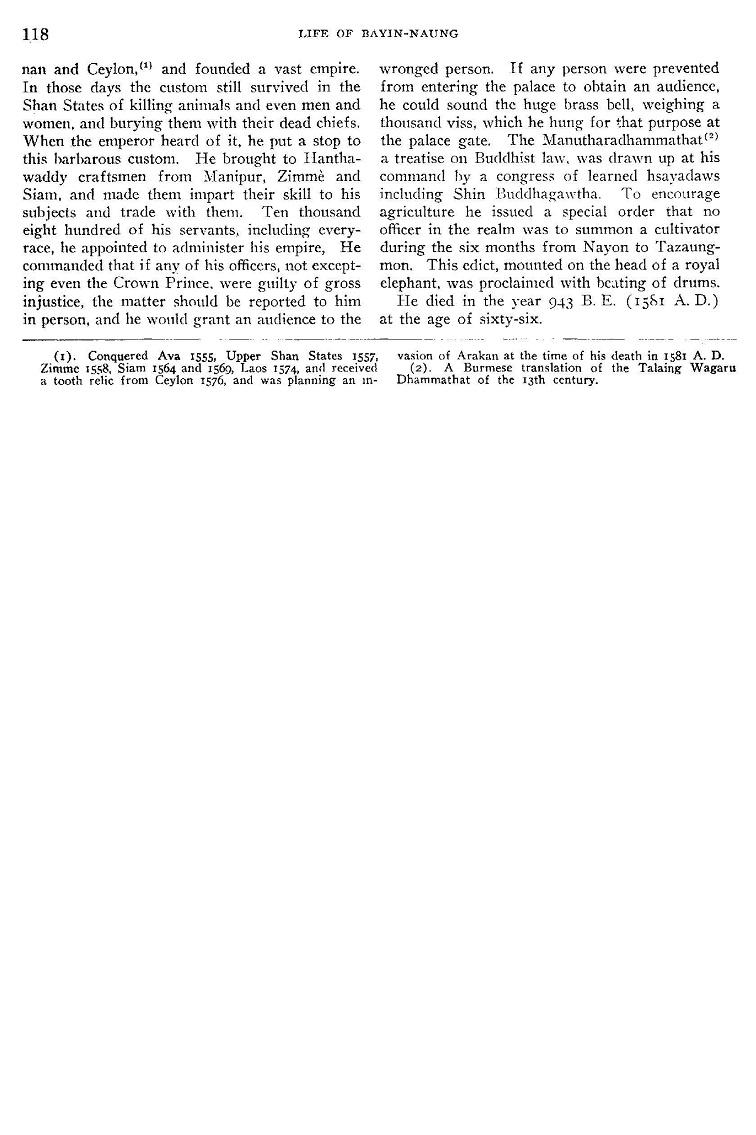
| Life of Bayin-naung Journal of Burma Research Society (JBRS) Vol 10, Part 3, 1920 |
|---|
 |
 |
 |
 Users Today : 0
 Total Users : 102974
This is a excellent blog, would you be involved in doing an interview about just how you designed it? If so e-mail me! Fast food
Thank you so much for your comment.
So, I came across your blog and I love this entry a whole lot. . How might I find out more?
Thank you so much for your appreciation. You can visit and see my main website Bagan ancient city.
https://baganpaper.com/