After Bagan declined as political power house as the result of the Tartar invasion the last two rulers namely Sawhnit (1298-1325 AD), Uzana (1325-1369 AD), lost control over the kingdom. They were mere governors exercising their power only at the capital. Three descendants of the Bagan dynasty who were half Shan and half Myanmar were three princes. Athinhkaya, Yazathingyan and Thihathu. They set up three principalities Myintsaing, Pinya and Sagaing ruled contemporaneously. They quarreled among themselves for power rivalry and family dispute. But they were united when the Tartars invaded their lands. Myint Saing and Pinya are located in the irrigated region of Kyaukse whereas Sagaing is just across the river Ayeyarwaddy, opposite to Mandalay. This period of the rule of three Shan brother princes and their dynasties was known as Pinya period which lasted only 66 years.

Though Shans were originally animists and they worshipped tribal Nats, Bagan’s missionary monks hand-preached the Dhamma in Shan states. Many Shans had embraced Buddhism. Besides the three Shan brother princes being descendants of Bagan dynasty were like Bagan kings, patron and promoters of Theravada Buddhism. Many religious monuments and monasteries were built at Myint Saing and Pinya, the ruins of which still survive.

In the case of Sagaing it was already famous as the centre of Buddha Sasana next to Bagan before it became a political power house in the Pinya period. Thirty seven hills in the Sagaing hill range along the Ayeyarwaddy River were the abode of holy recluses. Their names suggest the kings and the dynasties by whom and in which they were founded. For example there still is a holy recluse known as Anurudha recluse which was founded by king Anawrahta of Bagan. Therefore the kings of Sagaing were also patrons and promoters of Buddhism.
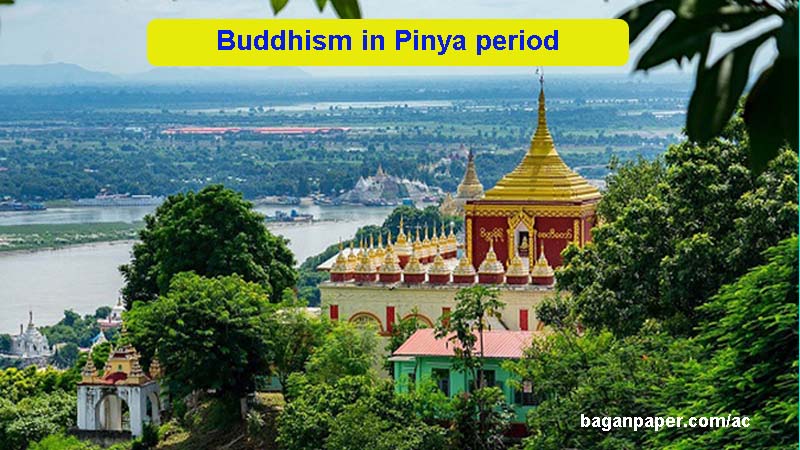
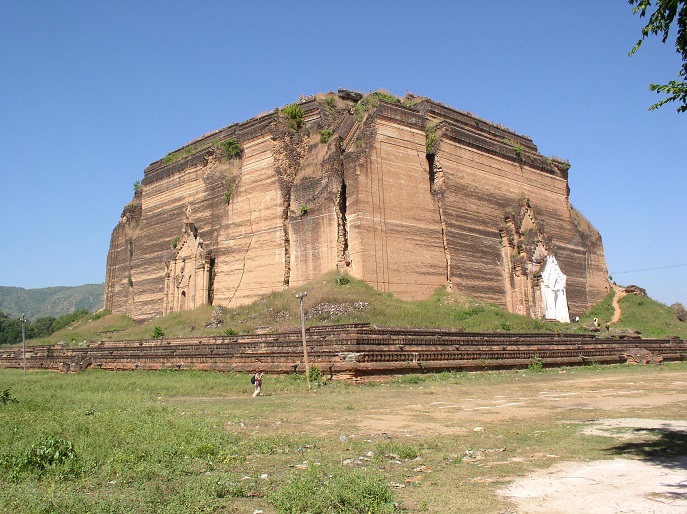
Mingun Pahtodawgyi (Sagaing)
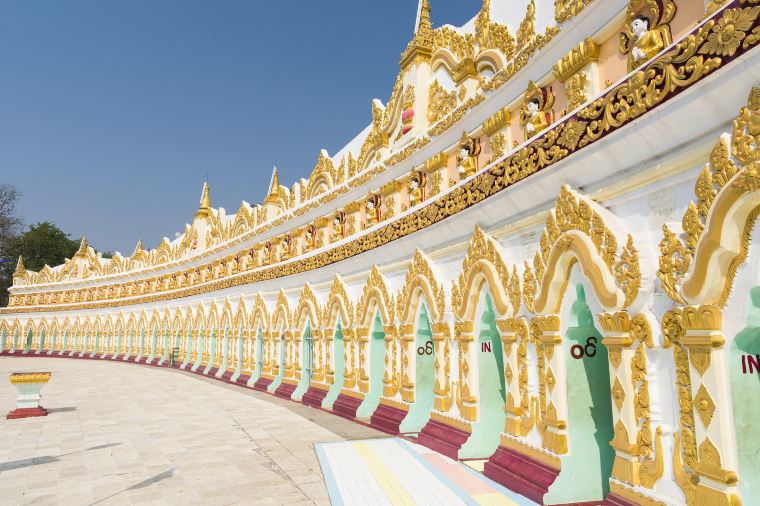
Soon U Ponya Shin Paya (Sagaing)
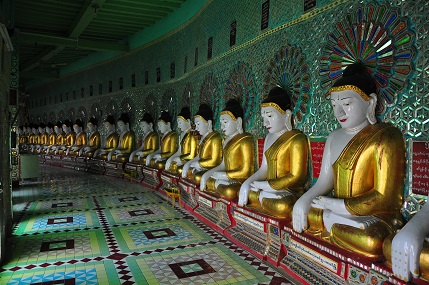
U Min Thonze (Sagaing)
U Min Thonze (Sagaing)
Among monk scholars of this period one popularly known as Su Twin Pyit Sayadaw was prominent because of his learnedness and scholarship as well as because of his strange life and career. During the reign of king Thihathu (1208-1312 AD), of Pinya period a large wooden monastery was built by the royal order. The king issued a royal proclamation that the monk, who hath the courage, let him take possession of this monastery. For some years the monastery was vacant. One day a monk on his home-bound journey from Bagan reached Pinya. On learning the royal proclamation he took occupancy of the monastery without informing anyone. This was reported to the king. The king sent Saturangabala, a very learned knight to the monk to test the latter’s learning and moral character. The knight after examining the monk’s knowledge and learning found that the monk was far more superior to him in learning knowledge and in all three Sasanas, Pariyatti, Patipati and Pativeda. The king donated the monastery to the monk.
စစ်အင်္ဂါလေးပါး- ဆင်လည်းတစ်ပါး၊ မြင်းလည်း တစ်ပါး၊ ရထားလည်း တစ်ပါး၊ ခြေသည်လည်း တစ်ပါး' ဖြစ် သည်။ Four military units (elephant, horse, chariot, and infantry)
Sturangabala (knight-cum-minister) Stu= four Anga= component (full of four components) bala = power / strength
Those four components are: 1. A comprehensive insight into grammar; 2. Compose skillfully in composing and writing poetry; 3. The question problem is asking more than others; (The worldly Dhamma, Asking deep questions about criminal matters) 4. The Art of Military Campaigning, Marching, Attacking, and Waging War
Some evidence suggests that he was unique in the game of chess.
Greetings sir,
I have confusion about one sentence “Though Shans were originally animists and they worshipped tribal Nats Bagan’s missionary monks hand preached the Dhamma in Shan states.”
I think there should be a comma in the middle as I put below.
“… they worshipped tribal Nats(,) Bagan’s missionary monks hand-preached the Dhamma in Shan states.”
Please correct me if I’m wrong. Thank you, sir.
Thank you for your kind comment. It is a typing error. So the end of the first clause must be inserted with a comma.
Sorry for late reply because of a hosting server error.
You truly did more than visitors’ expectations. Thank you for rendering these helpful, trusted, edifying and also cool thoughts on the topic to Kate.

 Users Today : 0
 Total Users : 102974
Greetings sir,
I have confusion about one sentence “Though Shans were originally animists and they worshipped tribal Nats Bagan’s missionary monks hand preached the Dhamma in Shan states.”
I think there should be a comma in the middle as I put below.
“… they worshipped tribal Nats(,) Bagan’s missionary monks hand-preached the Dhamma in Shan states.”
Please correct me if I’m wrong. Thank you, sir.
Thank you for your kind comment. It is a typing error. So the end of the first clause must be inserted with a comma.
Sorry for late reply because of a hosting server error.
You truly did more than visitors’ expectations. Thank you for rendering these helpful, trusted, edifying and also cool thoughts on the topic to Kate.
Thank you so much for your comment.