
Buddhism in lower Myanmar
In lower Myanmar, there was a Mon kingdom which was contemporary to Inwa kingdom. Bago (Hamsavadi), was its capital and the founder of the dynasty that ruled Mon kingdom was Wareru (1287-1296 AD). During his reign as well as the reigns of his Successors, Buddhism continued to flourish in spite of political changes. It was in Wareru’s time that monastic scholarship produced a code of law known as “Wareru’s Dhammathat”. It was compiled by learned Mon monk who based their Dhammathat on ancient Hindu codes of law. There was the revival of the tradition of Pilgrimage to Lankadipa (Srilanka), by Myanmar monks. Two noted Mon bhikkhus who went to Srilanka to get new ordination in the Mahavihara monastery were Ashin Buddhavamsa and Ashin Maganaga. To be ordained in the Kalyāṇī Sima near Maha Vihara on the bank of the Kalyāṇī River bhikkhus from abroad were required to revert to layman.

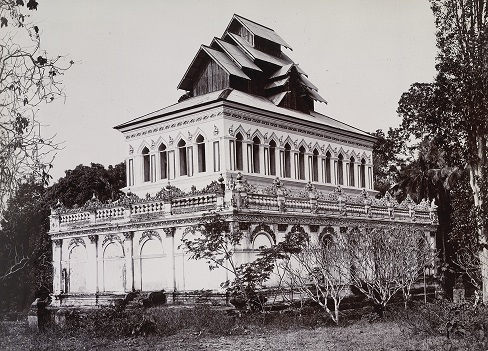
The orthodox Mahavihara believed that it was of the utmost importance that the ordination be handed down in an unbroken tradition from the time of Buddha. In this case foreign bhikkhus had to forego their ordained ages and had to consider that their former ordination was not valid. This orthodox concept of ordination in the Kalyāṇī Sima posed an issue for Myanmar bhikkhus. It was king Dhammazedi (Ramādipati) who settled that issue. He was the 16th king in the Wareru dynasty. His reign lasted 20years (1472-1492 AD). He was ex-monk whom Queen Shin Sawbu (1453-1472 AD), chose as her successor by marrying him to her daughter princess royal. The Kalyāṇī stone inscription at Bago set up in the precincts of Kalyāṇī Sima record great achievement of Dhammazedi. He unified the Sangha in his kingdom and purified the order of bhikkhus. He built many pagodas and monasteries and repaired and renovated the old ones. He sent a mission to Bodhgaya to repair and renovate the temple and make ground plans and architectural drawing of it, so that he could build their duplicates in his kingdom.

He himself had been a learned Mon monk who received education in monasteries at Inwa which adhered to the Vinaya of the Singhalese Sangha. The Singhalese Sangha accepted Mahavihara of Srilanka as the ultimate authority in religious matters. When he became king he started a reform movement to improve the discipline of the Sangha order in lower Myanmar. He chose 22 senior learned bhikkhus to lead the reform movement. He requested them to go to Srilanka and receive the Upasampada ordination in the Kalyāṇī Sima and brought home that seed of religion and planted it and caused it to sprout forth by conferring such ordination on men of good birth in his kingdom. In 1476 AD, 22 bhikkhus journeyed to Srilanka by sea in two ships. One reached it in two months. The other took six months to arrive there due to bad weather. In the Wazo (July) of 1476 AD, from 17th to 20th July, they were re-ordained in true tradition of Kalyāṇī Sima under Mahavihara Maha Thera. Thus altogether 44 Mon monks received ordination in the Kalyāṇī Sima. After staying there and studying Buddhist literature, they returned home. Their return journey met with difficulties. One group arrived safe and sound. The other group took three years to return to Pegu. The bhikkhus died during the journey.

Dhammazedi built a duplicate of Kalyāṇī Sima at Bago with the sand and plants water brought from the Kalyāṇī River Srilanka. In that duplicate Kalyāṇī Sima at Bago those who believed and desired to receive ordination at the hands of the bhikkhus who were ordained or preordained in Kalyāṇī Sima in Srilanka were ordained or preordained. But those who did not desire were allowed as they were without affecting their already attained seniority in Vasa. According to rule a chapter of five bhikkhus is needed to confer the ordination. One bhikkhu, qualified to serve as preceptor (upajjhāya), another bhikkhu to serve as teacher (ācariya). They must have attained at least ten years of ordained age. But none of the 34 monks ordained in the Kalyāṇī Sima of Srilanka had attained ten years of ordained age. But fortunately there still lived in Bago two bhikkhus who went to Srilanka and received the Kalyāṇī ordination at the beginning of the 15th   century. These two old Maha Theras acted as preceptor and teacher and they conferred ordination to many bhikkhus in the duplicate Kalyāṇī Sima at Bago. Dhammazedi built as many as 396 Kalyāṇī ordination halls throughout his kingdom, in which 15,666 ordinations took place; among them some bhikkhus from neighboring countries such as Laos, Chiangmai, Cambodia and Ayutthaya were included.

Dhammazedi issued order that all bhikkhus observed Vinaya strictly. Practicing arts, crafts, medicine, astrology and occult science involved breach of Vinaya and breakers of Vinaya rules were expelled from Samgha order. Himself having been in monk-hood for many years, king Dhammazedi knew how to reform and improve Samgha order with tact and prudence. He first approached influential learned senior bhikkhus and obtained their consent to his programme of religious reforms. Then he appointed a Samgha council to take the issue of laxity in Vinaya. As the king being a layman could not defrock a monk if he had not broken any of the four Pārājika rules. So he issued the order threatening to punish the mother, father, relatives and lay supporters and donors of a bhikkhu who broke the rules of Vinaya. That was an indirect action taken against a misbehaving bhikkhu by way of circumvention. Or he has the Samgha council to take direct action against the sinner bhikkhu. Dhammazedi showed that only secular powers (အာဏာစက်), could protect the Samgha order from malcontents who took advantage of the respect given to the yellow robe by stopping support. Dhammazedi’s fame spread beyond the borders of his kingdom because of successful religious reforms. Bhikkhus from other Buddhist countries came to his domain to receive ordination and study Buddhism at the monasteries. Kalyāṇī stone inscription at Kalyāṇī Sima at Bago records Dhammazedi’s religious reforms and works.
 |
| Dhammazedi |
|---|
| Dhammazedi and his companion, Dhammapala, were young Mons who entered the Buddhist order and settled at Ava, the new Burmese capital, after the fall of Bagan. It was in the third decade of the fifteenth century, when the kingdoms of Ava (Inwa) and Pegu (Bago) had fought each other to a standstill. The Forty-Years War – 1386-1422; – The war between Inwa (Myanmar Kingdom) and Bago (Hanthawaddy-Mon Kingdom), known to history as the Forty-Years War, broke out in 1385 was not a war of racial conflict between the Myanmar and Mons, but a mere war of personal rivalry between the king of Inwa, Mingyi-swarsawke and Razadarit, the king of Bago. The two Mons were very learned in the scriptures. The king of Inwa at that time had a Mon queen, the Lady Shin-Sawbu. She was the daughter of a very famous king of Bago, Razadarit (AD 1385-1423), and had been married twice before, first to a previous king of Inwa, and then, after his death, to a lord of Bagan, now deceased also. She was thirty-six and already a mother, but she still looked young and beautiful. However, she tired of life and informed the king of her desire to study the scriptures. The king appointed the two young Mon monks as her tutors, but after some months of study the queen and her tutors became conspirators (make secret plans with others), and one night in 1430 they fled down the river back to Bago. She did not marry again and settled down to a life of peace and tranquility. The beautiful queen and her two tutors were able to make the long journey by boat from Inwa to Bago. But twenty-three years later, in 1453, she was elected queen of Bago. She proved to be a great ruler until 1460, when she decided to become a religious recluse. Dhammazedi left the monkhood after he was selected by Shin-Sawbu as the heir apparent, and was married to one of the queen’s daughters. He was a Buddhist ruler of the best type, deeply solicitous for the purification of religion. Dhammazedi proved himself to be not only one of the wisest of kings but also one of the greatest patrons of Buddhism. |
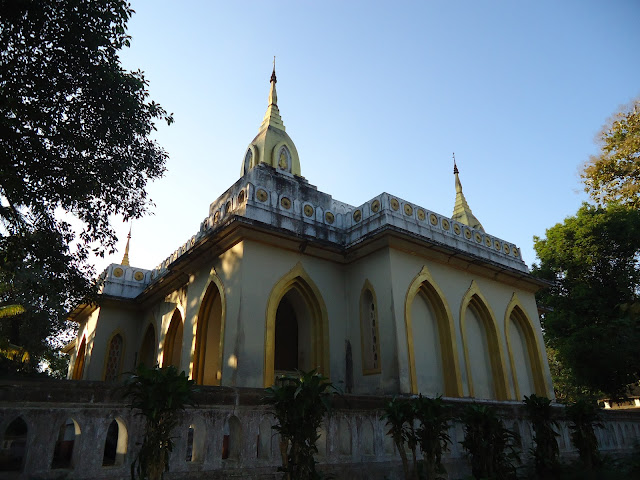
| The Kalyāṇī Ordination Hall in 1907 Pegu (Bago) Archaeological Survey of India Collections: Burma Circle, 1907-13 | The Kalyāṇī Ordination Hall (Recent) |
|---|---|
 |  |
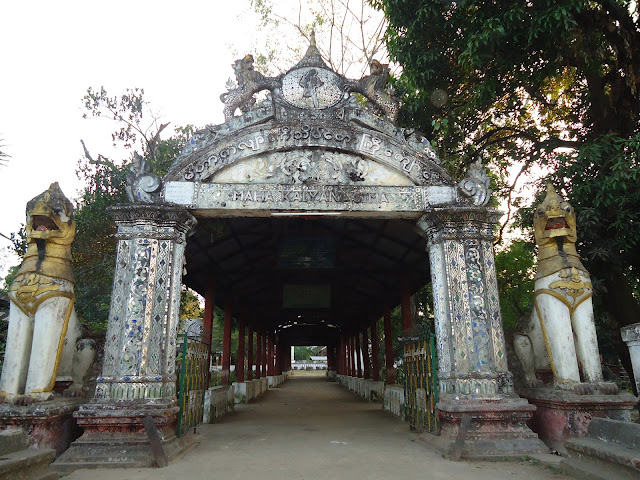
| Entrance Gate of Kalyāṇī Ordination Hall | Kalyāṇī Stone Inscriptions |
|---|---|
 | 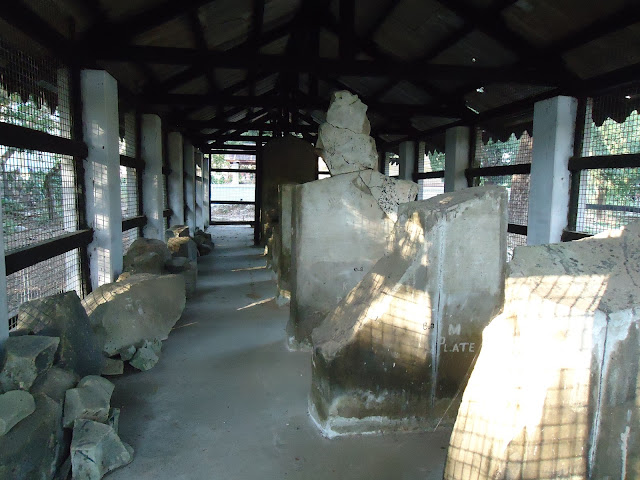 |
That holy Kalyāṇī Sima and stone inscriptions, in presence, could be studied near the Shwe Tha Lyaung Buddha Image at Ma-Zinn Ward in Bago and it plays the vital role in account of the history about Myanmar and Buddhism.

They comprise ten stone slabs covered with inscriptions on both sides.
Their average dimensions were about 7 feet high and 4 feet 2 inches wide, and 1 foot 3 inches thick. There are 70 lines of text to each face. The language of the first three stones is Pāḷi, and that of the rest is Mon, the letter being the translator language of the Pāḷi text.

-	Majjhimadesa Sāsanāvaṃsa
-	Sīhaḷa Sāsanāvaṃsa
-	Bagan Sāsanāvaṃsa
-	Rāmaññadesa Sāsana in the reign of King Dhammaceti
pārājika (n): 	gravest kind of offense meriting expulsion from  monkhood.  pārājika āpatti

Four Pārājika offences which lend to loss of status as a bhikkhu.

1.	Not to have sexual intercourse.
2.	Not to steal.
3.	Not to commit murder.
4.	Not to claim attainments of stages of pure mental concentration that have not been achieved.

(i) The first Pārājika: Whatever bhikkhu should indulge in sexual intercourse loses his bhikkhuhood.

(ii) The second Pārājika: Whatever bhikkhu should take with intention to steal what is not given loses his bhikkhuhood.

(iii) The third Pārājika: Whatever bhikkhu should intentionally deprive a human being of life loses his bhikkhuhood.

(iv) The fourth Pārājika: Whatever bhikkhu claims to attainments he does not really possess, namely, attainments to jhćna or Magga and Phala Insight loses his bhikkhuhood.

Click the following text to download Pārājika Pali Books

“Pārājika Pāli”, translated by Venerable Thumana

URLs: https://en.dhammadana.org/sangha/vinaya/227/4pk.htm

https://www.buddhanet.net/parajika.htm
 Users Today : 0
 Total Users : 102974